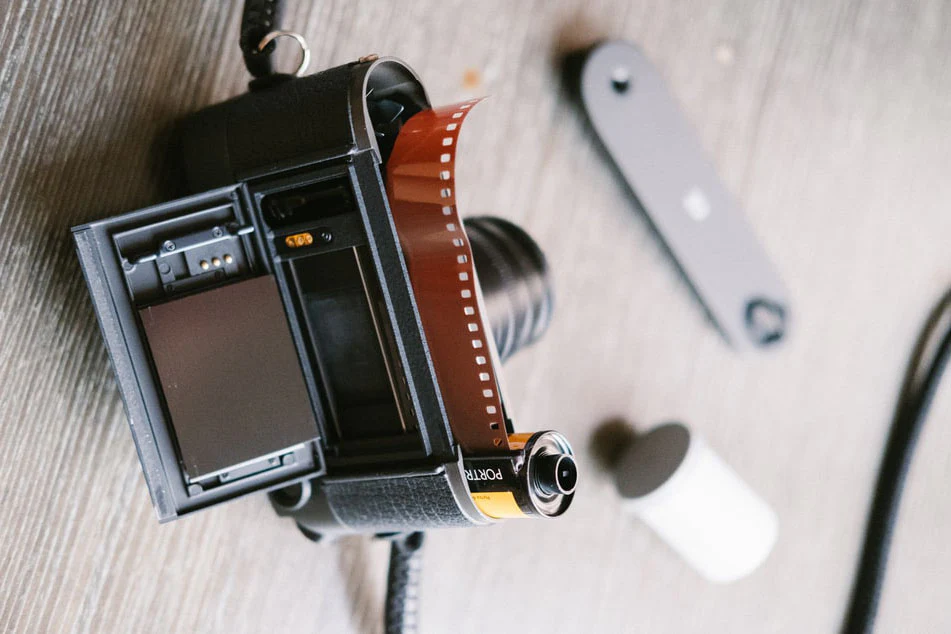

Wildlife photography is exciting as well as challenging and you need a versatile lens like the Nikon 200-500mm f/5.6. Imagine you are in an African savanna where you are photographing a grazing herd of Elephants at a distance, and right after that, you see a beautiful Eagle on the nearby tree. To photograph these types of objects, you need to have a wide range of zoom lenses. You may have experienced this while on a Safari. Changing a lens while in the field can be difficult.

Nikon 200-500 f/5.6 lens mounted on a camera, zoomed to 500mm
It looks like Nikon has considered the needs of Wildlife photographers and produced a versatile, fixed-aperture telephoto lens at a quite reasonable price; the Nikon 200-500mm f/5.6.
The Nikon 200-500 f/5.6 lens, priced at around US$1400, weighs about 2300g (81.02oz). The best part is the lens has a fixed maximum aperture of f/5.6. In addition to a fixed aperture, there are three extra-low dispersion glass elements (ED), powerful vibration reduction (VR) – making this lens optically superb – and it also comes with a tripod collar. The lens is stable when mounted on a tripod, and it comes with HB-71 lens hood. The lens also works great with both full-frame (FX) and crop-sensor (DX) Nikon cameras. The telephoto zoom range and beautiful optics make this lens perfect for birds, nature and wildlife photography.

This field review of the Nikon 200-500 f/5.6 lens, looks at how the lens performs from the perspective of a nature and wildlife photographer. It examines how this lens performs in the wild, as well as looking at the lens controls and ergonomics. This is important, especially if the lens has to be used from dawn to dusk in the wilderness.
This lens is versatile for photographing wildlife, mainly because of it’s:
The focal length of the lens is from 200mm to 500mm. Being FX lens, effective focal length on FX bodies is 200mm to 500mm. On DX Nikon bodies, the effective focal length is approximately 300mm to 750mm.
The lens is capable of photographing small objects such as this Ground orchid (at focal length of 310mm)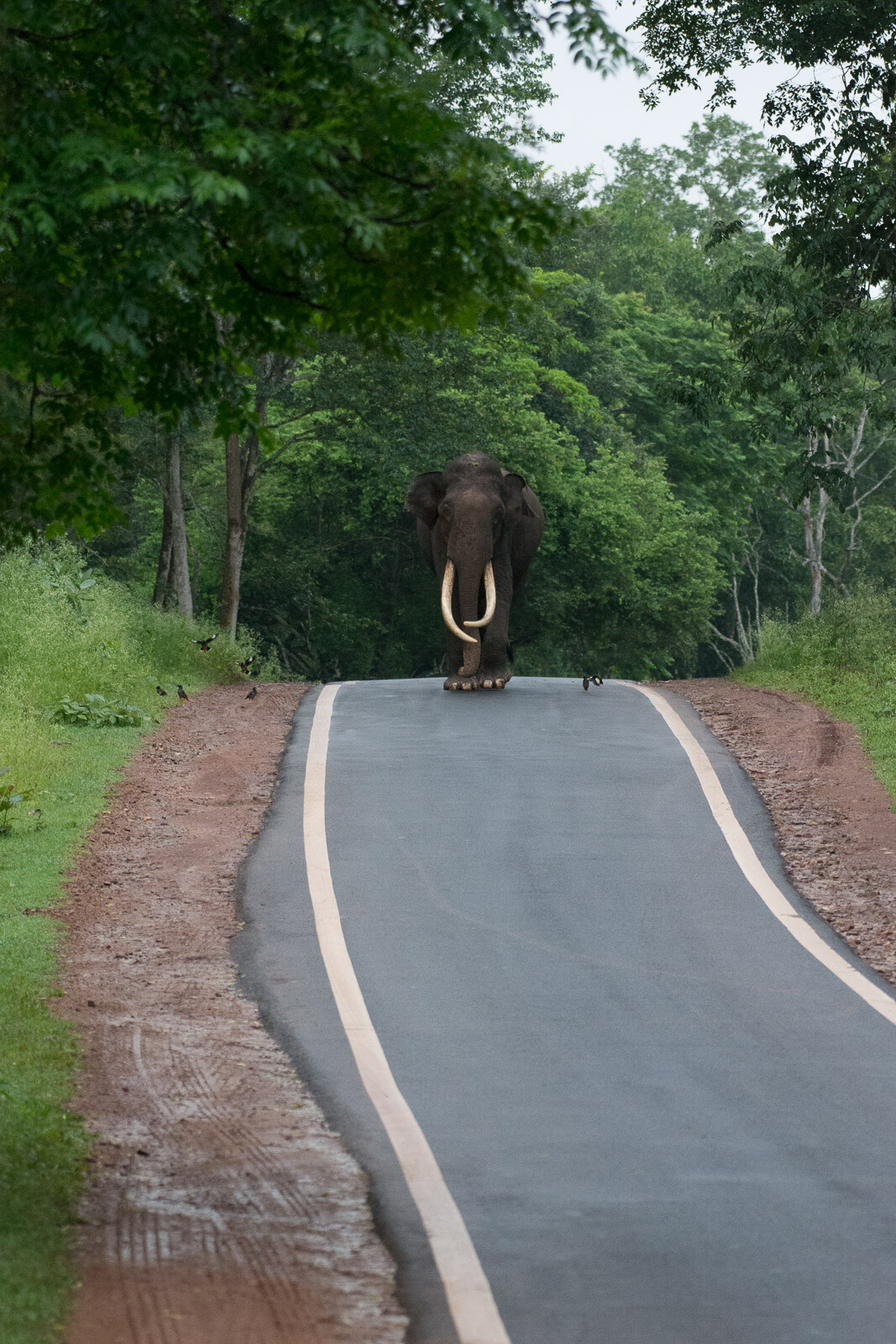
Image of large-sized Elephant approaching from a distance of around 300ft (110 yards) at a focal length of 200mm.
Image of large Elephant approached closer at a focal length of 500mm.
Small sized Oriental white-eye bird photographed at a close distance of 8ft at a focal length of 500mm.
The maximum aperture is f/5.6, and the minimum aperture is f/32. The Nikon 200-500 f/5.6 is an E-type lens (Electromagnetic diaphragm mechanism). It provides better control on the aperture blade as compared to mechanical linkages. This feature is compatible with newer cameras; however, with older DSLR cameras, an aperture is fixed to f/5.6.
The lens has 3 ED glass elements. ED glass element helps in reducing chromatic aberrations and offers overall better image quality.
This is the minimum distance between the lens and an object at which the lens focuses. The Nikon 200-500 f/5.6 has a minimum focusing distance of 2.2m (7.2ft). For wildlife and bird photography, this is a perfect minimum distance. With a minimum focusing distance of 7.2ft, the lens acquires perfect focus in most cases.
Thanks to Silent Wave Motors (SWM), the lens focuses quietly and with accuracy. The lens indicates this feature as AF-S. While you autofocus, you can instantly override autofocus by manual focus and vice versa (M/A). The lens can be focussed manually (M) as well.
The Nikon 200-500 f/5.6 is compatible with TC-14E III (1.4X) series teleconverters when used with DSLR cameras which can autofocus up to f/8. During low-light conditions, autofocus performance of the lens along with TC-14E III is satisfactory and usable. With the TC-17E (1.7X) and TC-20E (2X), aperture goes beyond f/8, hence autofocus is not possible. For this reason, it is not recommended you use the Nikon 200-500 lens with TC-17E and TC-20E teleconverters.
Full-frame (FX) cameras, crop-sensor ( DX ) DSLR cameras and Nikon mirrorless cameras (Optional FTZ mount adapter required) are compatible with the lens. This E-type lens (Electronic diaphragm) will work with the following cameras (you can change the lens aperture on these camera bodies): D5,D500, D4,D4S, D3, D3s , Df, D850, D810, D810A, D800, D750, D700, D610, D600, D300, D7500, D7200, D7100, D7000, D5600, D5500, D5300, D5200, D5100, D5000, D3400, D3300, D3200, D3100.
On older versions of cameras, such as Nikon D200, you cannot change the aperture. The aperture will be fixed to f/5.6.
The Nikon 200-500 f/5.6 accepts 95mm screw-on filters. When carrying this lens into the wilderness, I recommend you have a filter. It protects the front glass element from dust, mild drizzle and minor scratches. I use the filter while photographing and do not see any significant loss in image quality. However, make sure you use a high-quality lens filter to ensure minimal loss in quality.
This lens has excellent vibration reduction performance. I have achieved sharp images at 1/30th during low light conditions. Nikon claims to have the benefit of 4½ stops. I always keep the VR “ON.”
There are two VR Modes – Normal and Sports. Normal mode works fine for me while hand-holding the lens on the ground, and also in the safari vehicle. I tend to keep it set to Normal mode.
Image of Warbler bird with Vibration Reduction OFF. Feathers are not clearly visible Exif: 500mm f/5.6 1/400s ISO 2000, VR OFF
Image as it is from a camera with Vibration Reduction ON. Feathers are sharp. The lens is a handheld. Exif: 500mm f/5.6 1/400th ISO 2000, VR ON
Weighing in at approximately 2300g (81.2 oz), the lens initially feels somewhat heavy. However, as you start hand-holding this lens regularly, you get used to the weight. I am now able to handhold this lens for two to three hours without any issue.
The HB-71 Lens hood is a plastic hood. It is a decent hood but slightly big to fit in the bag. However, I do use a hood on the lens mainly to protect the front glass element of the lens from minor bumps, tree twigs, and rain.
The lens Diameter is 4.2inches (108 mm), and the length is 10.5 inches (267.5 mm) at 200 mm zoom. The lens fits perfectly in mid-sized camera bags such as Lowepro Flipside 400 with the body attached. You can invert and fit the lens hood as well.

Lens controls
The Nikon 200-500mm f/4.5 has five controls:
M/A – M
M/A means while autofocusing you can override it with manual focus if required.
M is a full-manual focus.
Full/Infinity – 6m
Full allows the lens to focus on the entire focusing range. I use Full all the time and have never missed the focus.
Infinity – 6m option limits the focusing range of the lens. The lens will focus from 6m to infinity. Any object which is closer than 6m won’t be in focus. I recommend using the Full option.
VR ON – OFF
Vibration reduction(VR) ON-OFF. Set this to ON. I set it to ON even when mounted on a tripod.
NORMAL-SPORTS
Set the VR type to NORMAL. For wildlife and birds, NORMAL mode works great. NORMAL mode works great while I am hand holding the lens and even in the safari jeep.
LOCK 200
The Lock 200 button locks the lens to 200mm. You cannot zoom the lens if it is locked. The lock switch is perfect for when you are traveling, and your lens is packed. It avoids unintended zooming during travel.
The lens is a bit heavy, but as you continue to use it, you will be able to easily handhold it. I found when hand holding the lens, removing the lens collar or rotating it upwards made it easier to hand hold. However, hiking with this lens can be hard due to its weight, especially carrying it up the mountains.
The zoom ring is smooth with an excellent rubber grip. The zooming feels smooth and is precise. However, the manual focus ring feels slightly loose. But, I do find the quality of manual focus to be excellent.
The Nikon 200-500 f/5.6 fits in a mid-sized camera bag. However, to accommodate the lens and camera, a larger bag is required. The only awkward part is the lens hood. Either you can invert the lens hood and keep in the bag or use a slightly bigger bag. I use this lens with Lowepro Flipside 300 (only lens), and the Lowepro Flipside 400 when the camera is attached.
The weather sealing of this lens is quite decent, and I have used this lens in a moderately dusty forest and some drizzle. The lens offered good weather sealing. Make sure you clean the lens after using it in dust and drizzle. I clean the front element, outer lens barrel, and mount. I use a Nikon Lenspen Pro kit for cleaning which is easy to use and travel-friendly.
The overall construction of the lens is good. It can handle minor bumps. However, some parts are made up of plastic, making the lens construction not as rock-solid as pro-grade lenses.
Wildlife actions happen in a few seconds. Focusing speed is most critical for wildlife photography. The speed of focus with Nikon 200-500 f/5.6 is good. When the light conditions are good – such as morning and early evening – this lens focuses fast and accurately. I use back button autofocus. I have used this lens in forest, safari, grasslands, and drizzle. Here is how this lens exactly performs in the field –

Hawk cuckoo bird in the rain. Low light image and photographed from a safari vehicle.
Flight of fast-diving paradise flycatcher. Lens focussed on this fast-moving bird in good light conditions.
This bird was behind the grass. There was significant clutter in front of it and the lens focussed accurately on the bird.

Average focus performance when photographing small objects such as a flying kingfisher at a distance.
A Peacock photographed when it was raining. The lens managed to autofocus decently during low light and rainy conditions.

Crested Hawk Eagle chasing Heron. The birds were at a longer distance and photographed during very low light conditions. Lens focus performance is a bit on the poor side.